

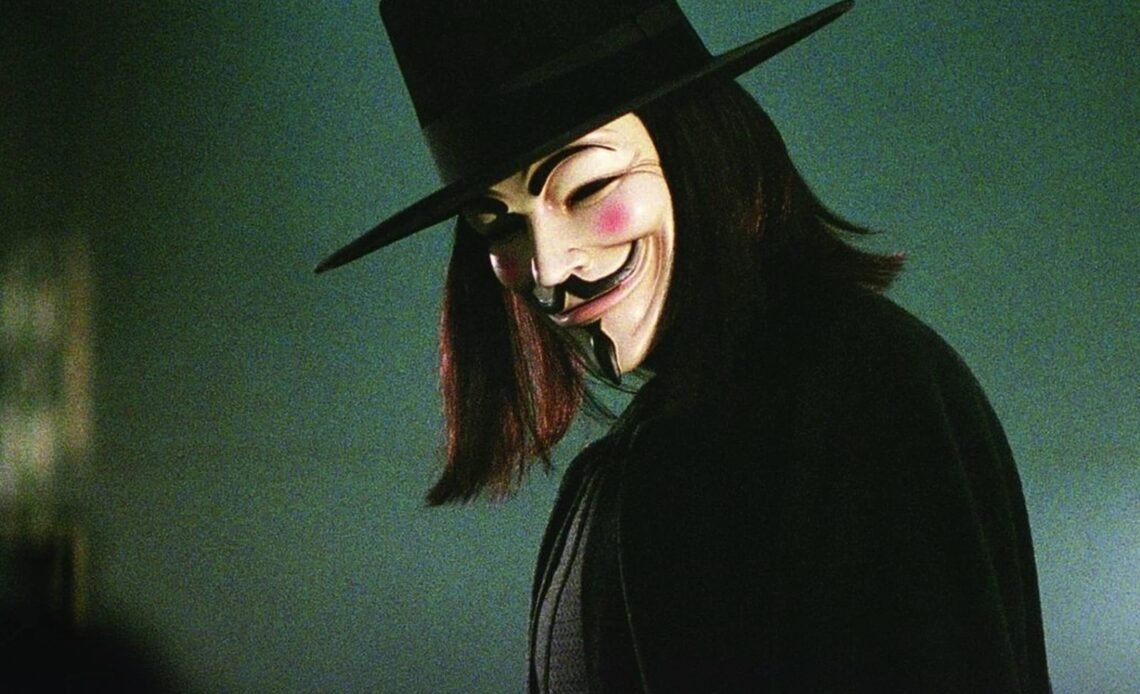
Every year on November 5, one movie takes over timelines. “Remember, remember the fifth of November” is the opening of an old English rhyme about the Gunpowder Plot of 1605, when Guy Fawkes was caught guarding barrels of gunpowder beneath the House of Lords. Two decades ago, V for Vendetta turned that rhyme into a rallying cry.
Released in March 2006, the film was directed by James McTeigue from a screenplay by the Wachowskis, adapted from Alan Moore and David Lloyd’s graphic novel. Set in a totalitarian future Britain, it stars Hugo Weaving as V, a masked revolutionary waging war on the regime, and Natalie Portman as Evey Hammond, the young woman he pulls into his plan. Portman famously had her head shaved on camera for one of the film’s most intense scenes.
The supporting cast included Stephen Rea, Stephen Fry and John Hurt as the tyrannical Chancellor Adam Sutler, a sly twist for an actor who had played Winston Smith in the 1984 film of George Orwell’s Nineteen Eighty-Four. Remarkably, Weaving never shows his face once; James Purefoy was originally cast as V but left early in production, and Weaving stepped in behind the mask.
The movie was first set to open around November 5, 2005, before being pushed back to the following spring. Its explosive finale was shot around Whitehall and Westminster, with the filmmakers securing rare permission to film in the heart of London.
Its legacy outgrew the screen. The smiling Guy Fawkes mask was adopted by the hacker collective Anonymous and by protesters around the world, becoming one of the most recognizable symbols of dissent of the 21st century. Moore distanced himself from the adaptation and had his name taken off it, but the film went on to earn more than $130 million worldwide and a lasting cult following.
So tonight, as the fireworks go up, remember V’s words: ideas are bulletproof.